Home ⁄ Archive by Category "editing tips"

This Month’s Writing Tip: Enjoying the “Process”

I recently saw an interview with the cast of a Quentin Tarantino movie with the actors saying they celebrated regularly throughout the whole filmmaking process, and not just at the end. Apparently Tarantino subscribes to the belief that if you are involved in a creative pursuit, you should enjoy all of the process not just the “red carpet” bit at the end.

This resonated with me because as an author the “process” can be exhausting at times. Writing a book can take a long time. Editing a book can take a long time. And publishing a book can take…you guessed it, a long time. So, if you don’t enjoy the whole (or most of the) process, what’s the point?

I’ve found that there’s always some aspect or several aspects of writing that an author doesn’t enjoy. For some this may be marketing themselves. For others it might be asking for feedback. For me, I find structural edits a hard slog – some days it feels like you’ll never get the damn book finished, right?

While I think it should be expected that you won’t like everything about the job of writing, there are definitely some things you can do to make the hard parts, less hard.

Here are a few ideas:

  • Break big tasks into smaller achievable chunks.
  • Do the stuff you like the least, first up in the day – get it out of the way so you can move on to the things you do like.
  • Remind yourself that there will be an end to whatever stage or task you’re working on.
  • Focus on your end goal and how that will feel.
  • Talk to other writers who understand the “process” and can commiserate, cheer you on and even offer helpful advice.
  • Ask for help – if it’s something you don’t know how to do, then ask someone who does know.
  • Outsource to a professional – if it’s something that make sense to outsource, and you can afford to do so, delegate the task to a professional.
  • Have other projects on the go. If, for example, you don’t like the editing process and you know it will go for a while, have a side project where you’re working on something you do like. Perhaps, have a short story on the go, or start planning a new novel. Just be careful, though, not to fall victim to “shiny new object” syndrome.
  • Work to a favourite playlist. I have a bunch of playlists that I go to when I need extra motivation. I’ve found for instance it’s very difficult to hate what I’m doing if Salt ‘N’ Pepa is playing in the background – but maybe that’s just me : )
  • And most importantly, celebrate every step of the way! Share with your (writing) friends and family when you have completed a stage or task. Choose something meaningful to you to mark your achievement, whether it’s taking a long bath, reading a book – or treating yourself in some other way.

Writing, in my opinion, is the best job in the world, so why waste your time hating on the “process”?

To stay in the know about my books and to receive regular writing tips and content like this, sign up here.

Feedback

The Biggest Thing Standing Between You and Writer Success

Okay, you got me. There are actually many variables that determine whether you succeed as a writer – not just one thing. If there was an exact magic formula there wouldn’t be a need for anyone to blog about this stuff…but…there is, in fact, one critical factor that determines just how good you get as a writer. And that one thing is feedback.

Over the last twenty plus years, I have worked as a journalist and editor on daily newspapers and magazines. I have written all forms of marketing and communication content for globally listed companies, government, SMEs and not-for-profits.

The reason I tell you this is to demonstrate I’m no stranger to feedback. In my first gig as a cadet journalist in the 90s I quickly learned how to write better.

Pumping out half a dozen and more stories a day, I had to write fast but also well enough to avoid the sub-editor angrily stomping down to my desk and pulling apart my story line by line. I’m not sure about newsrooms these days but sub-editors back then didn’t mince their words when it came to feedback. If they knew about the feedback sandwich, they certainly didn’t subscribe to it.

I later worked for a head of a government department who was known for scribbling ‘What is this BS?’ in giant red letters across anything he didn’t like – fortunately I never received one of those.

Now I’m not saying these were great ways to get the best out of a writer or that everyone should have to experience this, but it definitely taught me a lot about the importance of feedback and how to deal with it. 

Specifically, here are the key things I’ve learned.

1. Be Open to Feedback

Everyone….I mean EVERYone needs some form of feedback and editing.

No matter how experienced you are as a writer, we can all do with a second pair of eyes.

Often as writers, we are so close to our work that we don’t notice things that might stand out to another person.

You may have read your work a hundred times (and sometimes it does feel like that) but completely missed a typo. As the writer you also have all the pieces of the puzzle in your mind, you know the background and whole plot, but you may not have translated enough of those puzzles onto the page for the story to make sense to the reader.

A good reader/editor will tell you which parts or syntax that weren’t clear to them. They may even make useful suggestions about how to improve a sentence, phrase or segue.

2. Be Brave

Presenting your work to others for feedback for the first time is a big step. Putting your precious words out to the world (even if it’s just to one other person) takes bravery.

I mentioned earlier that I was used to the idea of feedback…but that was in relation to my news and corporate writing.

When it came to my creative writing, it was a completely different matter.

For many years (nearly a decade) I tinkered away at my first novel – my first serious attempt at creative writing. Those years of writing and refining and attending courses were important to learn my craft but only up to a certain point.

The harsh reality was that my novel wasn’t going anywhere until I was prepared to share it with someone.

I was writing in a vacuum. I felt safe in my vacuum but it was a confined space. Nothing can truly grow in that kind of environment.

It was only when I was brave enough to share my novel that I was able to really improve my work – and the rate of improvement was rapid! Only after that point did I enjoy any form of success with my creative writing. I started entering competitions and submitting my work to industry professionals. 

My work started getting recognised and I took what feedback I was given and improved my work more.

3. Ask the Right People for Feedback

I tweeted recently about how my mum insisted on reading my draft YA fantasy novel, even though she doesn’t read YA and “hates” fantasy.
This is an example of someone I shouldn’t be asking for feedback.

The people you ask to review your work, will depend on what kind of feedback you’re looking for.

Here’s who you may like to ask for what.

  • Avid Readers of Your Genre – These readers can give you very useful feedback on whether your story and characters meet their expectations. They are more likely to be invested in your story so their feedback may go beyond structural feedback to character voice and line edits.
  • Family and friends – If your family and friends don’t read your genre, prepare yourself for the fact that they may not enjoy your story, regardless of how good it is. Unless they have a writing background their feedback may not be particularly useful. If they insist on reading your work, let them, but you can’t be sure of hearing what you want to hear. If you’re expecting a pat on the back and to be told how awesome you are, then you may be disappointed. For those of you whose family and friends are the cheer squad types, take the encouragement. Use it to boost and motivate you, but don’t kid yourself. This kind of feedback does little to make you a better writer.
  • Writing friends – People in your network or writing groups that are professional writers, or are on the same creative writing path as you, can provide really helpful feedback (as well as support and encouragement). Regardless of the genre they write in, writers “get” other writers. They can provide invaluable feedback at a structural and line edit level. Just make sure though you are working with people whose opinions you respect and trust.
  • Grammar police types – We all know those people – whether their friends, family or workmates – who know their em dashes from their en dashes. By all means ask these people for help once you’re ready for proofreading. 

4. Seriously Consider All Feedback

If you have asked someone for feedback and they have taken the time and effort to give it, then you should seriously consider all of their suggestions.

It’s completely natural to not agree with every piece of feedback you’re given but it’s important to take a beat and challenge your thinking when it comes to each and every suggestion…even if it means you have to do a lot of work.

Ask yourself, would their suggestion make the story better?

If you’re not completely sure, engage the person who gave you the feedback in a discussion about their suggestion or ask for a second opinion.

Generally, when I have ask a specific person for feedback (they will be someone I trust) I will take on board around 90% of their changes. 

Of course, if you’ve been given feedback that is not in keeping with your voice, story and characters, feel free to ignore it – perhaps even explain why to the person who gave the feedback.

5. Feedback You Must Take on Board 

There are some forms of feedback I believe you should always take on board. These have nothing to do with stylistic feedback or authorial voice, it is to do with clarity.

If a reader has flagged something that doesn’t make sense to them, or is unclear, then I personally believe you should listen to them.

The way I see it is that if one person didn’t understand something, there’s a good chance that others won’t.

Unclear writing jolts a reader out of a story, which is the last thing you want to happen.

While it is possible that your writing is clear and it was just one particular reader who had an issue, the fact they mentioned it is enough reason to check the section and/or get a second opinion.

Yes, feedback is tough. Feedback can hurt. But feedback is also the single most important tool for becoming a better writer.

To stay in the know about my writing projects and to receive regular writing tips and content like this, sign up here.

Author marketing

Brand & Marketing Myths Every (Aspiring) Author Needs to Know

“It is a truth universally acknowledged, that an (aspiring) author in possession of a book (idea) to sell, must be in want of an author brand or platform.”

I’ve taken some liberty with Jane Austen’s words but I’m sure she would have agreed with the sentiment.

Jane Austen lived at a time when books by women were usually published anonymously. I like to think she would have jumped, in a most lady-like manner, at the chance to promote herself as an author.  

Why then do many (aspiring) authors, who want to get their books out into the world, consider marketing a necessary evil, or just downright evil?

The answer lies in the undeniable fact that creating an author brand or platform can at times be frustrating, confusing or annoying – ‘you mean I actually have to do social media?’.

The good news is that many of the objections or challenges relating to marketing can be overcome with a little persistence and the right guidance.

Unfortunately, this does nothing to address the many misconceptions that continue to plague marketing and stop some writers from embracing their author brand.

I’m here to restore your faith in marketing by busting some of the most common myths surrounding author brand and related topics.

Branding is for Businesses Not Authors

The easiest way to clear this one up is to ask yourself whether you want to make money from selling your books.

If you answered yes, then you need to treat your writing as a business, otherwise, it’s a hobby.

Being a professional writer or author entails all of the regular activities a business owner needs to undertake, marketing being one of them.

Your author brand is the foundation of all of your marketing activities, and it is much more than having a beautiful logo and business cards.

Brand is the experience or feeling you create every time you interact with the world. It is what you say and how you say it – it is how you make people you communicate with feel.

It is about creating a consistent voice for you and your writing that resonates with readers, publishers, agents, and other people important to your success.

I Don’t Need to Worry About Brand Yet

If you haven’t published a book yet, you may think it’s okay to wait before developing your author brand.

In fact, the best time to start marketing yourself as an (aspiring) author is now!

The more time you have to build your platform, get followers and refine your messaging, the easier it will be when you are querying agents and publishers, or are ready to launch your book.

I Don’t Like Selling Myself So I Don’t Like Marketing

Guess what? Most people don’t like ‘selling’ themselves and no one likes being ‘sold’ to.

Fortunately, marketing isn’t about ‘selling’. It is about making meaningful and authentic connections with people who are interested in you and your work.

Connecting with the right people through social media and other communication channels builds a support network of people who, when the time comes, won’t just buy or invest in your book, but will do the ‘selling’ for you. They will become your brand fans and ambassadors.

To stay in the know about my writing projects and to receive regular writing tips and articles like this, sign up here.

Editing Your Novel

Need to Edit Your Novel? Here’s How to Do It

So you have finished your novel. First and foremost, CONGRATULATIONS!!!

Finishing that first draft of your novel is no mean feat. But while it may be tempting to send it off to an agent or publisher right now, your novel isn’t likely to be ready.

The stark reality of first drafts, is that they are drafts, which means they inevitably need editing.

At some point in time you are going to need some fresh eyes on your work, but the first step is to edit your own work.

It is important to remember that a novel could go through a series of revisions, and the process could take a while but not to feel disheartened – this is a part of the process all writers must go through.

The Three Stages of Editing

The first series of revisions usually relate to the big picture and any structural issues. It’s often referred to as the structural edit. This is where you check on the plot, the goals of your character. You may also choose to correct any errors you discover along the way.

In the second revision, you may approach your edits chapter by chapter or scene by scene, focusing on flow. You will also be reviewing copy line by line to check for consistency, voice and tone, word choice, and other issues that might keep the novel from moving smoothly line by line. This is called the copy or line edit.

The final edit you conduct is what is called proofing to spot any typos or grammatical errors.

Beta Readers

Depending on where you are at with your novel, it might be a good idea to rope in someone else to read your work at the same time. Ideally, you will line up a few beta readers to read a draft that you consider ‘almost ready’.

While it may be tempting to approach family and friends, they do not always make the best beta readers.

Good beta readers are usually avid readers of the genre you are writing in, so can provide informed feedback about how to improve your novel.

Other useful beta readers are people experienced in writing or editing and are passionate about the craft.

It’s always a good idea to give your beta readers some specific questions to keep in mind when reading your novel.

Here are some questions you may like to use for your own editing, as well as for beta readers:

  • Were you hooked from the start? Did you want to keep reading?
  • Did the story hold your interest? If not, why not?
  • Did the following feel vivid and real to you?
    • The setting
    • Characters
    • Dialogue.
  • Were there any parts that confused you? Or even frustrated or annoyed you? Which parts, and why?
  • Did you notice any discrepancies or inconsistencies in time sequences, places, character details, or other details?
  • Do you have any other specific comments you’d like to add that would help improve this story?

Other Self-editing Tips

Change the font type of your manuscript with every round of edits

It’s very easy to get used to reading the same font over and over again. This makes it difficult for your eyes to recognise and spot errors, especially typos.

A neat trick is to change the font after each time you edit. Think of it as the equivalent of a fresh pair of eyes, except that your novel went through a fresh look.

Let it sit for a while

If you have the time and willpower for it, it’s always a good idea to put your novel away for a few weeks or more, to give your brain a break and to give you enough clarity when you come to editing.

Don’t overdo it

Editing is different from writing in the sense that you should not do it all day. Make sure you take breaks and divert your attention somewhere else. When you get back to editing, you will feel refreshed and ready to work with a full charge.

Use editing apps

You will find plenty of apps online to help with editing but the Hemingway app is one of the most in-depth as it tells you when a sentence is hard to read, points out complicated words and adverbs, and offers simpler suggestions for words.

Lastly, hire a professional editor. It may seem counterintuitive considering the work you’ve gone through but a pro can polish your novel further. And that work you’ve gone through will help you grow and improve as a writer, as well as improve your chances of getting published. So take a deep breath and get out that red pen today.

To stay in the know about my writing projects and to receive regular writing tips and content like this, sign up here.

Just When You Think You Can’t…Ganbatte

Writing a novel may be hard work but it’s nothing compared to the gruelling task of editing…at least that’s my experience.

You see it’s possible to get on with the task of drafting a novel, even on days when the muse doesn’t show up, you can just keep at it. If you just write, the words slowly add up and eventually you will reach your goal.

The beauty of the drafting process is that you don’t have to overanalyse your words. Most of the time, I can get in the flow and not think too much about the words I’m using.

The most important thing is just getting the words down.

When drafting a novel, I focus on having discipline and word count targets. This may not work for everyone but it does for me and ensures I stay motivated. Setting myself tangible goals, that relate to nothing else other than word counts, means I can make positive progress.

As a result, I find that completing the first draft of a novel is relatively pain-free, and dare I say it, enjoyable! – I knew there was a reason writers put themselves through this torture on a regular basis.

Things though quickly unravel when I get to the first edit or revision of my novel.

At this point, things become a little less tangible. The first edit isn’t about picking up typos and formatting errors, it’s about much more subjective components.

I have to look at my work critically and ask whether the structure, story and characters work, as well as, many other potentially soul-destroying questions.

My Own Worst Critic

Reviewing your own work requires you to embrace your inner critic, but what if you’re too critical of your writing?

If you’re anything like me, you may be your own worst critic and this can send you on a rollercoaster of emotions.

The typical editing process means you can experience any or all of the following on any given day:

  • Imposter syndrome – “I’m not a proper writer, who was I kidding?”, ” I’m a fraud”.
  • Second guessing – “should I change that?”, “I’ll just change that back”, “Was the original version better?”.
  • Negative self-talk – “I can’t believe I wrote this rubbish”, “What was I thinking?”, “I’m not good at this”, “I might as well give up now”.

Occasionally I do have moments, and sometimes days, when I feel like I’m ‘winning’ at editing. I may come across a section of prose that I may not even recall writing and I marvel at it, believing that I may actually be okay at this fiction-writing gig.

Unfortunately though the times I feel like the cat’s pyjamas and am convinced I could be the next JK Rowling, are few and far between.

All too often I feel paralysed and have multiple crises of faith when it comes to editing my novel.

When You Just Can’t

After a lot of trial and error, procrastination and excuses, I’ve found one thing that keeps my editing on track. It’s ‘Ganbatte’.

I’m a self-confessed Japanophile, having lived there for a couple of years, and I have a go-to list of Japanese words that inspire me.

‘Ganbatte’ is one of my favourites. It roughly translates as: keep at it, do your best, don’t give up and work hard.

Japanese often use the phrase ‘Ganbatte kudasai (please)’ in the same way we would wish a person good luck before an exam or performance.

Ganbatte though is less about luck and more about tenacity. As a culture, Japanese value effort and perseverance and this is a quality that I remind myself to embrace whenever I hit upon a difficult editing phase.

Just when I think I can’t keep going with my editing, or there’s no point in trying, I channel the Japanese warrior in me – yes I like to think there’s a little samurai in all us writers –  and tell myself ‘Ganbatte!’.

You never know, it may work for you too. ‘Ganbatte kudasai!’

To stay in the know about my writing projects and to receive regular writing tips and articles like this, sign up here.

The Big Bad Truth about Blogging and Content Marketing and Why Your Business Should care

Content marketing and blogging remains one of the most effective marketing strategies for businesses.

Your online content has never mattered more.

In fact it REALLY matters. The Content Marketing Institute cites numerous studies that show:

  • Small businesses with blogs get 126% more leads than businesses without blogs.
  • 77% of internet users read blogs.
  • 61% of consumers have made a purchase based on recommendations from a blog.
  • Websites with blog content have 434% more search-engine indexed pages – making your business easier to find on Google.
  • Content marketing generates 3 times the leads and 6 times the conversions, while costing 62% less than other marketing methods.

I know this first-hand because I regularly work with global marketing specialists and agencies. I also ghost-write for one of the world’s leading Content Marketing Experts, featured numerous times in Forbes magazine.

So what’s BAD about what I’m telling you?

It’s not bad if your business already has a content marketing and blogging strategy.

However, if you aren’t creating and distributing valuable content – preferably original content – then you may be missing out on valuable lead generation and sales opportunities.

I’m not talking about advertisements or blatant brand promotion. I’m talking about useful and interesting content, such as blog or online articles, relevant to your target audience.

The intention of the content, of course, is to stimulate interest in your brand and result in the reader taking an action, but this is achieved by being helpful as opposed to salesy.

How to Get Started

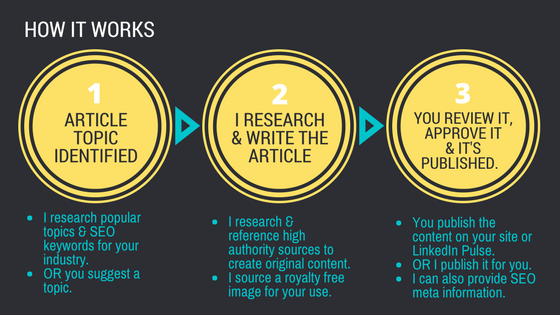
Regular blogging via your website, or publishing online articles on sites such as LinkedIn Pulse is relatively simple when you work with a professional writer.

You can get high quality blog articles and online content in a cinch – and it will only take 10 minutes of your time.


Check out our blog writing packages. You may also like to check out my blogging FAQsContact me now for high quality content.

Top 5 sci-fi and fantasy couples

In the spirit of Valentine’s Day this week, I wanted to go with my top 5 couples of sci-fi and fantasy.
1. Han Solo and Princess Leia, Star Wars
So yeah, a little predictable, but I’m a sucker for this love-hate relationship. One of my favourite lines from Han Solo:
‘Look, I ain’t in this for your revolution, and I’m not in it for you, princess. I expect to be well paid. I’m in it for the money’
2. Princess Buttercup & Westley, The Princess Bride
Westley is pathetically devoted to his long lost love Buttercup, but who could help but fall for his charms when he responds to your every request with: ‘As you wish’.
3. Daenerys Targaryen and Khal Drogo, Game of Thrones
So they had a rocky start with that child-bride arranged marriage to a savage thing, but it didn’t take long for animalistic love to bloom.
4. Arwen and Aragorn, Lord of the Rings
A devastatingly dark and mysterious mortal falls for an immortal Elf. It could have been a little Romeo and Juliet doomed but true love won through in the end.
5. Madmartigan and Sorsha, Willow
Reckless, disgraced and disheveled, Madmartigan becomes smitten by a fairy spell and declares his love for Sorsha, who he hates.
He has no recollection of his love declaration and when questioned cries out in complete disgust and shock: ‘I don’t love her, she kicked me in the face!’
Shame it didn’t work out in real life for this once-were married couple.

So go ahead and celebrate this Valentine’s Day with a movie marathon featuring my favourite couples.
To stay in the know about my writing projects and to receive regular writing tips and content like this, sign up here.

The longhand experiment – saying goodbye to distractions

I sat down three times this week to write this blog. Three times. Each of which was unsuccessful.
The problem is that every time I sat down at the computer, I found something more urgent or more tempting to devote my time to.
Whether it’s emails, funny cat videos or a seemingly important business matter that comes to your attention, it’s hard to keep focused when you are on the computer.
And this is where my larger problem lies. 

The pen (or quill) is mightier than the keyboard

I have great intentions of sitting down and working on my novels, but the moment I put fingers to keyboard I find a thousand other things I “need” to do on the computer.
Without fail, it doesn’t take me long to abandon my writing in favour of other distractions.
It’s hard enough staying motivated throughout the extended drafting, revision and editing process, without having pop-ups and alerts enticing you to wish someone happy birthday or guilting you into checking your mail every two minutes – just in case something urgent pops up.
For someone like me, who loves information and learning new things, a computer can be an addictive place. I can disappear down Google’s rabbithole for hours on end, and in the meantime that book just doesn’t get edited.
This brings me to a shocking conclusion. When it comes to creative writing, I just can’t afford distractions.
Call me crazy, but I’m going to start using good old fashioned notepads from now on…well I definitely will try on the next novel. In the meantime I am going to print out my existing drafts and revise in long hand.
Yes it will probably take me a long time and I’m going to have to type it in anyway at some stage, but I’m in good company. 

JK Rowling favours longhand.
Image from http://jamesruncie.com/

Plenty of famed writers favoured old school pen and paper including Truman Capote, JK Rowling and Joan Collins. 

And if that isn’t enough of a good reason, let me give you some more benefits of writing in longhand.
  1.  Notepads are portable and don’t need batteries
  2. It is free of internet distractions
  3. It will make you a better writer. At least that’s what plenty of authors say, because it encourages you to give more thought to your words. Many will do their first drafts and revisions in longhand and then edit as they type up their notes
  4. You will retain more because putting ink to paper stimulates a part of the brain, the Reticular Activating Centre, or the RAS that enables you to focus on the information you are writing.
  5. It’s a good brain exercise as writing engages your motor-skills and memory. 

For now I will continue writing my blogs and attending to business matters via the computer, but I’ll be picking up the pen and paper for the creative longhand writing experiment.  And maybe, just maybe I will see some of the above benefits and if I’m very fortunate, I might actually finish my first manuscript. So here it goes…

Find out more about me and my writing at www.kyliefennell.com 

13 tips for writing and editing your first novel

I’ve earned a living as a professional writer for more years than I care to admit.
I can pump out 1,000 words on almost any topic and edit them to a professional standard, well before the boss screams down the phone ‘one minute till deadline’.
That might sound like a bit of a brag-fest, but it’s not meant to be. It’s meant to illustrate the stark contrast between my corporate writing experience and my creative writing.
As I’ve mentioned before I’m in the process of editing my first fantasy novel series. I’m a novice when it comes to novel writing and editing and I can tell you it is a case of: same but different.
While I can apply my corporate writing knowledge and skills to my creative projects, the practices are distantly related cousins rather than siblings.
For me the key differences are:
The length of time– it comes down to simple maths. Writing and editing 100,000 words takes significantly longer than 1,000 words, making the task all the more overwhelming and complex
Subjective criticism– creative and particularly novel writing is a completely personal and subjective experience. Corporate writing usually involves facts, figures and quantitative research. Most of the time you can be reasonably objective. When it comes to novels you tend to continually question and overly criticise your work. It’s almost impossible for me to look at my creative work objectively.
For these two reasons, I tend to go through various stages (which I suspect are common to many novelists). I swing back and forth between loving what I’m writing/editing, to hating it, to despising it, to wanting to give up on it, then back to loving it again. On a good day I’m filled with confidence and pride, on an average day I’m thinking ‘it’s not so bad’ but then there are the other days.
These are the days you discover a major plot hole 200 pages in, that means revising every other page. It becomes a case of one chapter forward and 200 pages backward.
I look back at my ‘writing my first novel’ self and laugh knowingly in her face. “You thought that was hard? Well, editing your novel will be (at times) the hardest and most demoralising thing you’ve ever done.” I tell myself. Yet we do this with no promise of financial reward at the end.
Lucky for people like me I still think the process is worth it, in spite of all the pitfalls. Frankly, I don’t have a choice. I must write and these novels must be written. But how can it be done without sending myself spare?
The ever resourceful and helpful Queensland Writers Centre, which I’m eternally grateful to, highlighted in a recent editorial that “there’s writing, and there’s finishing”.
The editorial reminds us that until we “complete a working first draft, we won’t know how to fix our story in the rigorous editing and polishing stages to follow”.
  
So in this post, I want to focus on ways to stay on track when it comes to writing your first draft and how to stay positive and motivated throughout the writing and editing stages. Let me begin first with the disclaimer that I am no means an expert when it comes to novel writing, but this is what I’ve learned so far.
  1. Just write – write anything. If you can’t bring yourself on a particular day to write your novel, write something else. Write about the ‘writing process’. Write a mock letter to your main character. Write a list of your character’s favourite places. The daily process of writing is critical. When you’re not sure, or downcast, just keep writing, just keep writing.
  2. Set goals – set yourself achievable goals for the week/month/year and regularly track how you’re going. Revise goals if you need to, but be careful not to make your targets too low or too high.
  3. Set aside time – find the time of day that best suits you to write or edit, whether it is first thing in the morning or late at night, as long as it suits you. Set the time aside and stick to it. Any stint longer than 4-6 hours though may become unproductive.
  4. Reward yourself – when you do achieve your goals, reward yourself.
  5. Identify recurring distractions and eliminate them (if possible) – if you notice that you are commonly distracted by household demands while writing from home, get out of the house and go to the library or a café or park to work. Turn off mobile and social media if you can.
  6. Make notes as ideas come to you – have a notebook and pen on hand or type notes directly into your phone when they occur to you. I’ve been known to record voice memos while driving (using the hands-free and voice activation functions on my phone).
  7. Find things that inspire you – I actively look for phrases, images, films, books or music that inspire me. I have a Pinterest board for general writing tips and inspirational quotes and another for my fantasy writing pins. Pinterest can suck up time quite easily but can be therapeutic if you monitor your time carefully. Start a blog like this one. Read books that inspire you. Create a playlist of music that could be the soundtrack for your novel. Watch your favourite movie that is from the same genre or style of your novel.
  8. Learn more about your craft – read credible books about writing. Join a writers group. Go to writing events and workshops such as the those held by the Queensland Writers Centre.
  9. Combat blocks – if you are truly stuck, ask yourself ‘What if?’ scenarios or questions about your setting, plot or characters.
  10. Take a break (just not too long!) – step away from the computer if you are finding it all too overwhelming. Take a walk. Go get a coffee.
  11. Understand when perfection is required – You may have heard the phrase that ‘first drafts don’t have to be perfect. They just need to be written’. This pin from novel-software.com describes the draft and edit stages. Your first edit is really draft two. In draft one you go like the clappers and don’t look back.  In draft two you start to refine and improve. You don’t focus on polishing and editing or cutting until draft three. Draft four is for tweaking and polishing. Only after then will you be – or preferably a second pair of eyes – proofreading. So when a loved one offers ‘to edit for you’ when you are still in draft two, politely explain the above process. This may also prevent or minimise the endless ‘how’s the editing going?’ questions. You may like to engage a trustworthy friend or fellow writer to act as a betareader for you in the later stages as well. They can help identify plot holes, continuity or flow issues.
  12. Don’t beat yourself up and believe in yourself – writing and editing a novel is a mammoth task. Congratulate yourself on how far you have come. When you are feeling despondent, seek out people who believe in you. Seek out those people who will tell you how wonderful you are and how awesome your book is going to be. Alternatively, if you need a kick up the backside, find the person you know who will give that to you.
  13. Never, ever, ever, ever give up – if you can’t stop yourself from wanting it, don’t stop trying.
As a final piece of inspiration, here is a great quote from www.KarlBimshas.com

“When you cannot think: write; When you cannot speak: write: When you cannot sleep: write; and if you cannot write: read”.
To stay in the know about my writing projects and to receive regular writing tips and articles like this, sign up here.